Services
sonaTune
“Is my handpan in tune?”
sonaTune answers it with objective data. Every measurement can be saved as a report — a reference you can trust when buying, selling, or maintaining an instrument.
What a report records — sample
The report on the left, transcribed. Saving a session keeps exactly these values.
| Slot | Note | Deviation |
|---|---|---|
| DING | D3 | +2.1 |
| TONE 1 | A3 | -3.4 |
| TONE 2 | Bb3 | +1.8 |
| Slot | Note | Deviation |
|---|---|---|
| TONE 3 | C4 | -2.6 |
| TONE 4 | D4 | +4.2 |
| TONE 5 | E4 | -3.1 |
| Slot | Note | Deviation |
|---|---|---|
| TONE 6 | F4 | +2.4 |
| TONE 7 | G4 | -5.3 |
| TONE 8 | A4 | +1.5 |
Harmonics — the heart of a handpan
Every note repeats when all three modes meet — one fundamental period.
Unlike most instruments, a single handpan tone field sounds three partials at once. The maker tunes the field's tension evenly so that one field vibrates in three modes — the tonic, the octave, and the compound fifth. Their frequencies form an exact 1 : 2 : 3 ratio: the three waveforms meet at a common point again and again and ring as one voice, and it is this alignment that gives a handpan its clear, resonant tone and long sustain.
When the alignment drifts, the three partials no longer fuse — the note turns dull and its bloom fades. A handpan is also built so that one note's partials share frequencies with other notes, so striking one field sets the others resonating and the whole instrument blooms. How precisely these harmonics align is what defines a handpan's tone and the quality of its making — and it is exactly what sonaTune measures.
What sonaTune is
Sees only the fundamental
Sees all three partials at once
All three partials aligned — a clear, focused voice
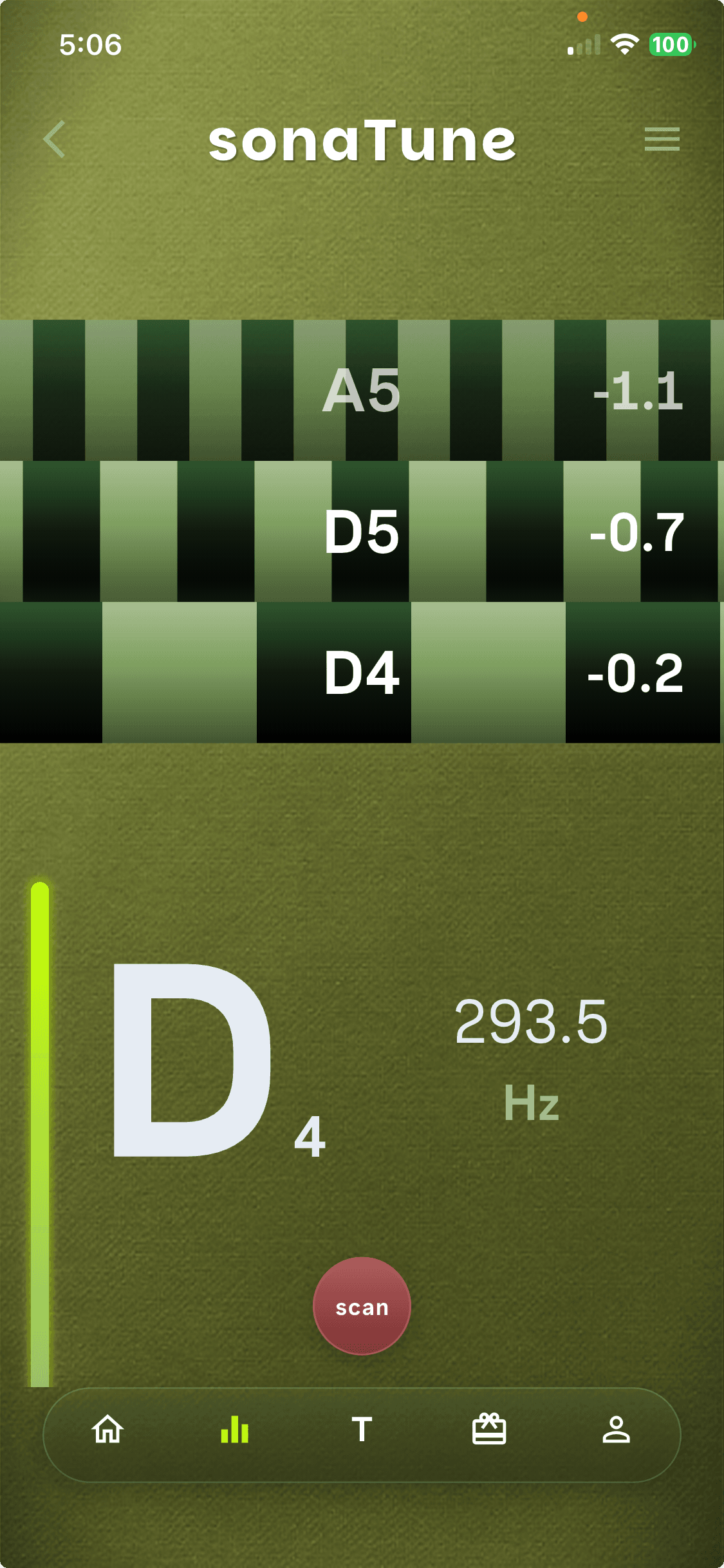
Play the same D3 and an ordinary tuner calls it in tune, while sonaTune catches the octave D4 inside it drifting.
An ordinary chromatic tuner reads one fundamental per note. But a handpan note is three partials ringing together — the tonic, the octave and the compound fifth — so even when the fundamental is right, a drifted partial has already dulled the sound. With no proper tool to check this, players have had to judge their instrument's condition by ear alone.
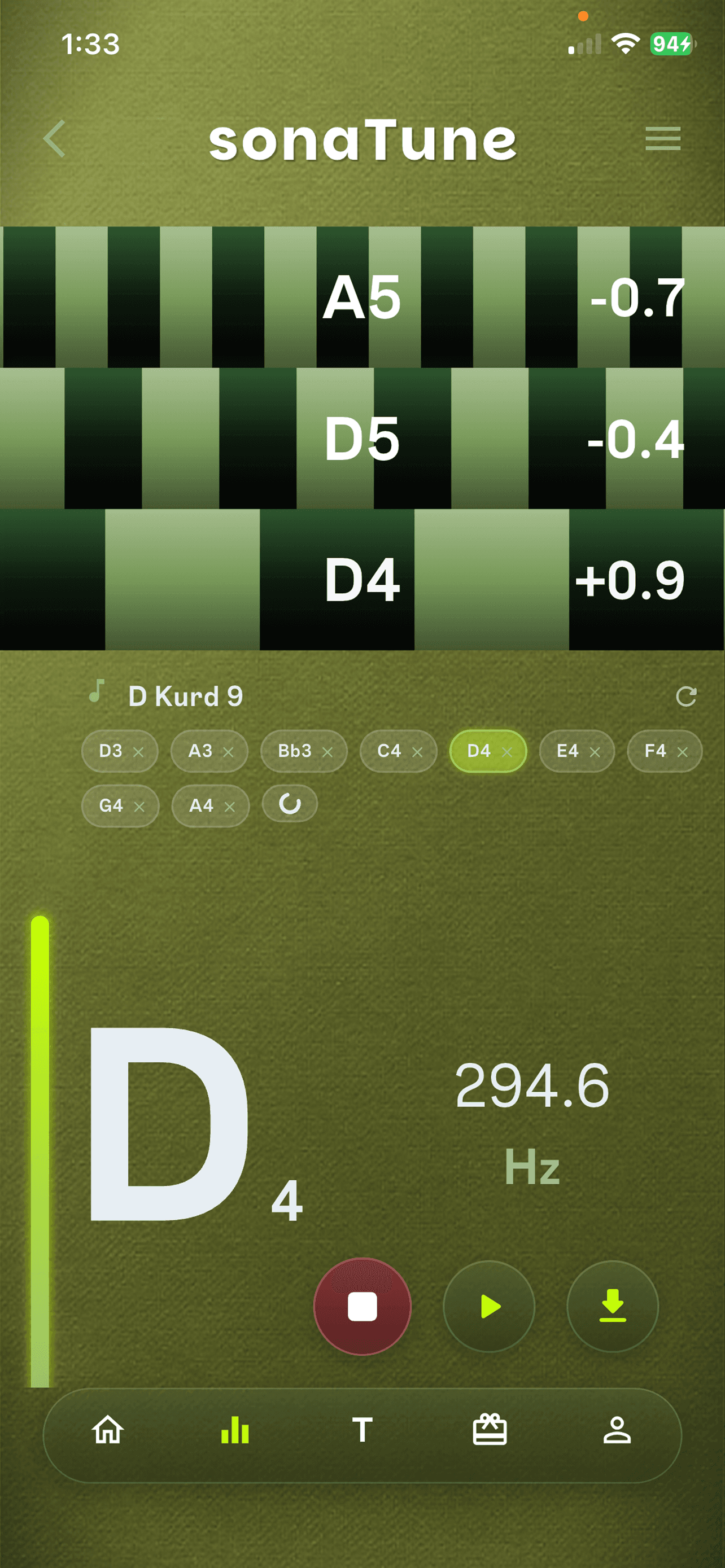
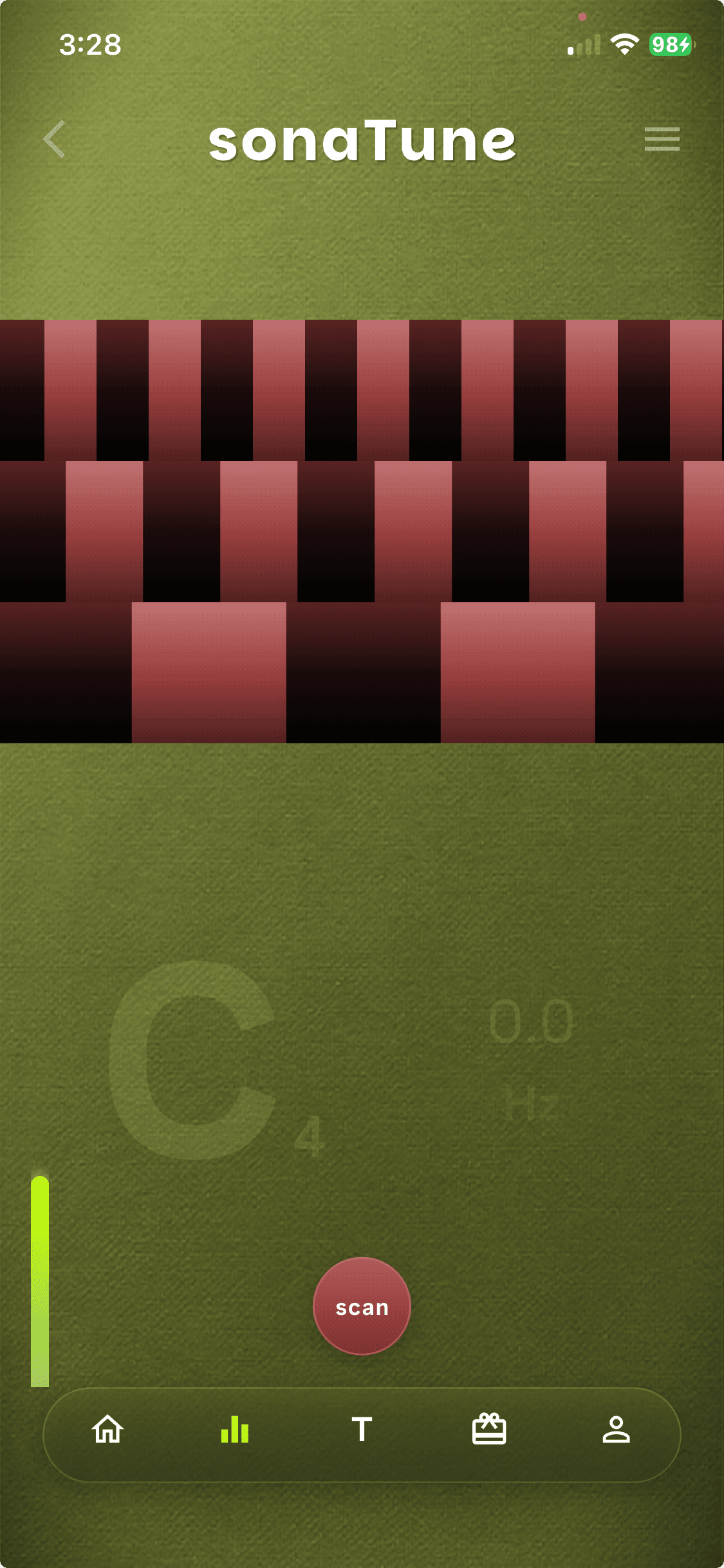
sonaTune is a multi-harmonic strobe tuner built by a handpan maker to solve exactly this. Three strobe bars track the three partials at once, judging each in Hz and cents against equal-tempered targets. Strike a tone field and the note is recognized instantly; when a bar holds still, it is in tune — no extra gear, just the sona app and your phone's microphone. Checking your instrument is no longer expert work: anyone can do it, easily, right in the app.
Key features
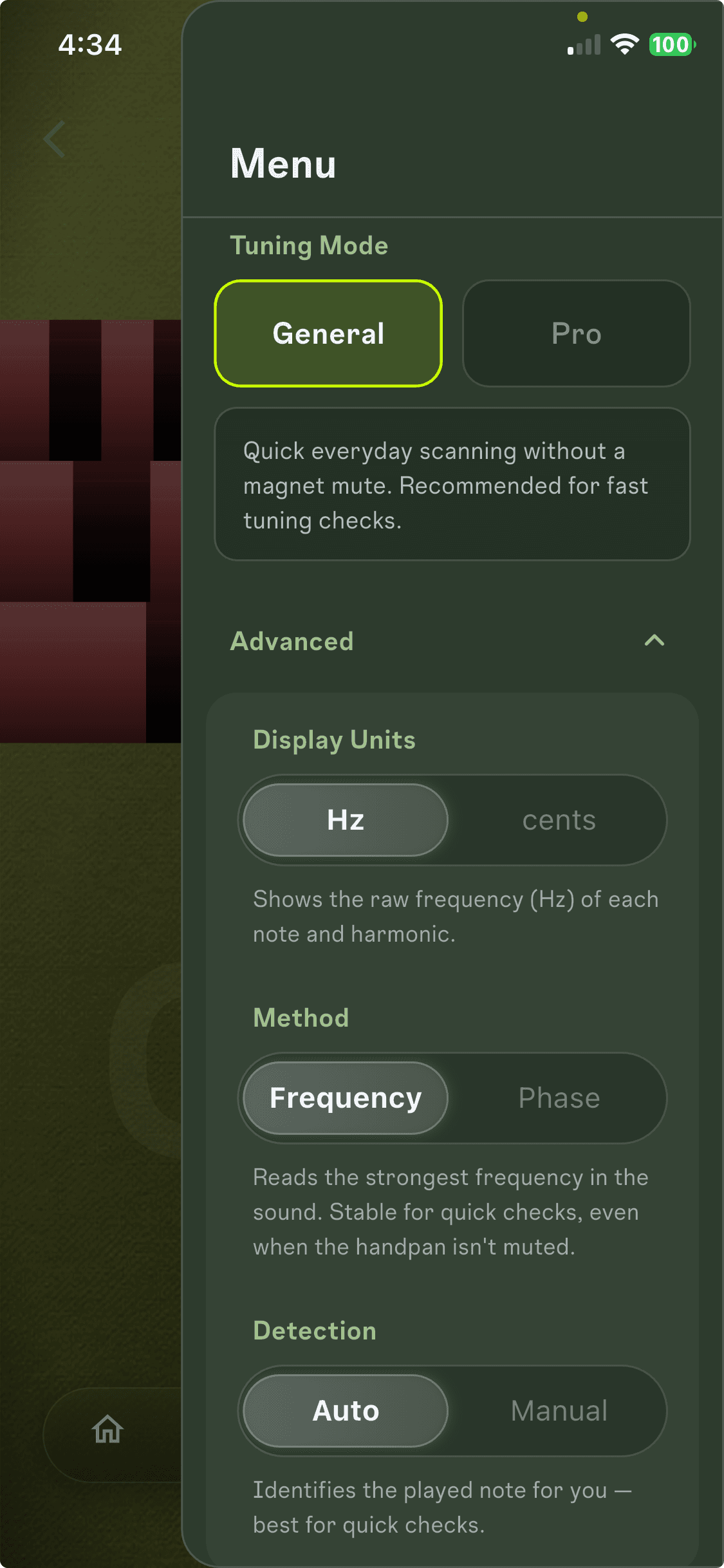
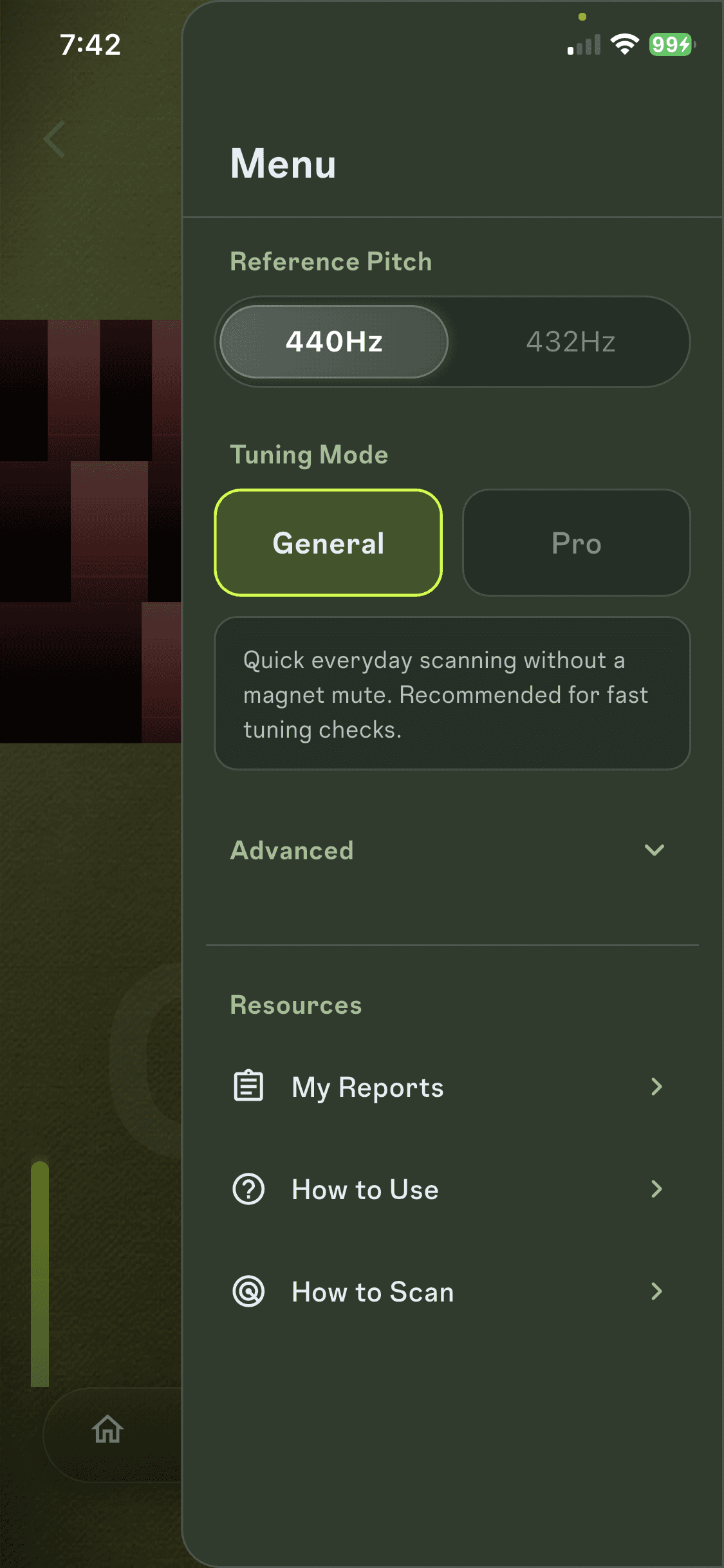
Reference pitch
440 Hz, the modern standard, or 432 Hz, used in sound healing.
Mode
Method
Reads the strongest frequency in the sound. Stable for quick checks, even when the handpan isn't muted.
Detection
Identifies the played note for you — best for quick checks.
Measuring your handpan
Before you measure
- Work in a quiet environment.
- Rest the handpan on a stand, cushion, or your lap so the Gu — the hole in the bottom shell — stays unblocked.
- Hold the phone microphone close to the tone field you're measuring.
- For the most precise reading, mute the other tone fields with a magnet and measure one at a time.
How to measure
Reading the report
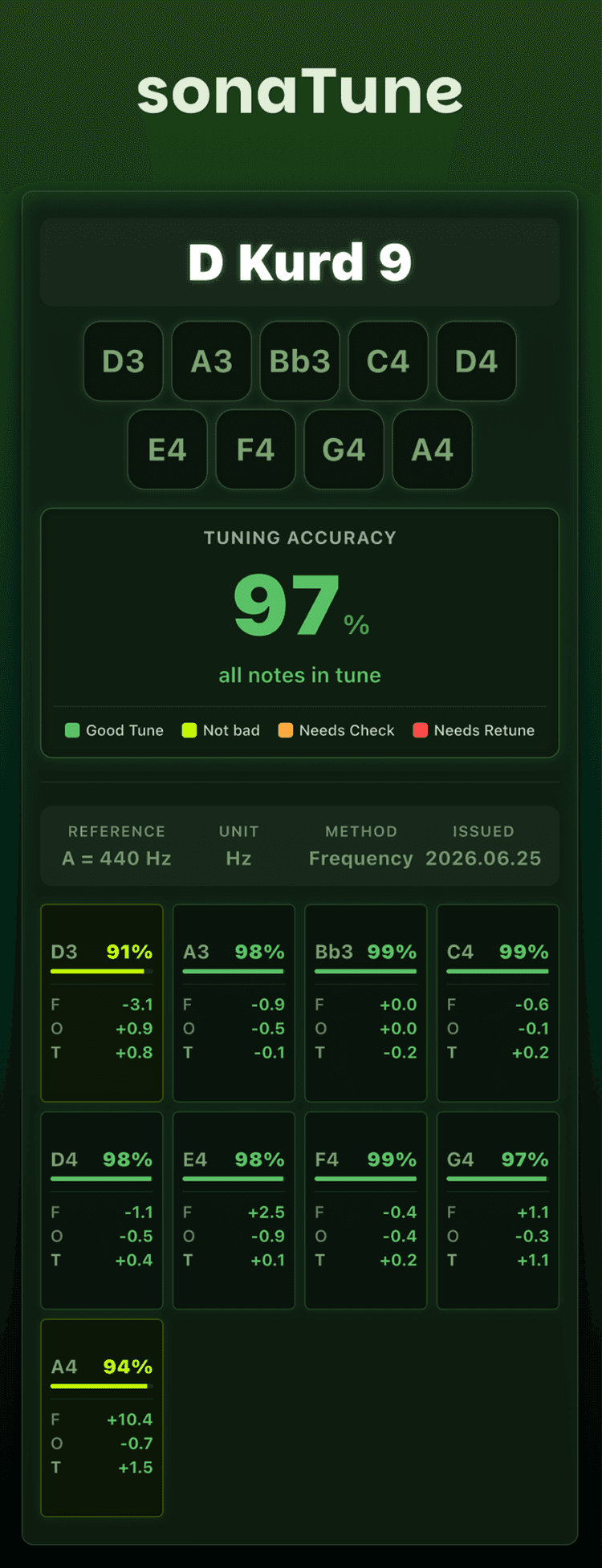
Sample report — tap each numbered zone to learn how to read it.
100 minus the weighted average error across all notes — the higher, the closer to in tune.
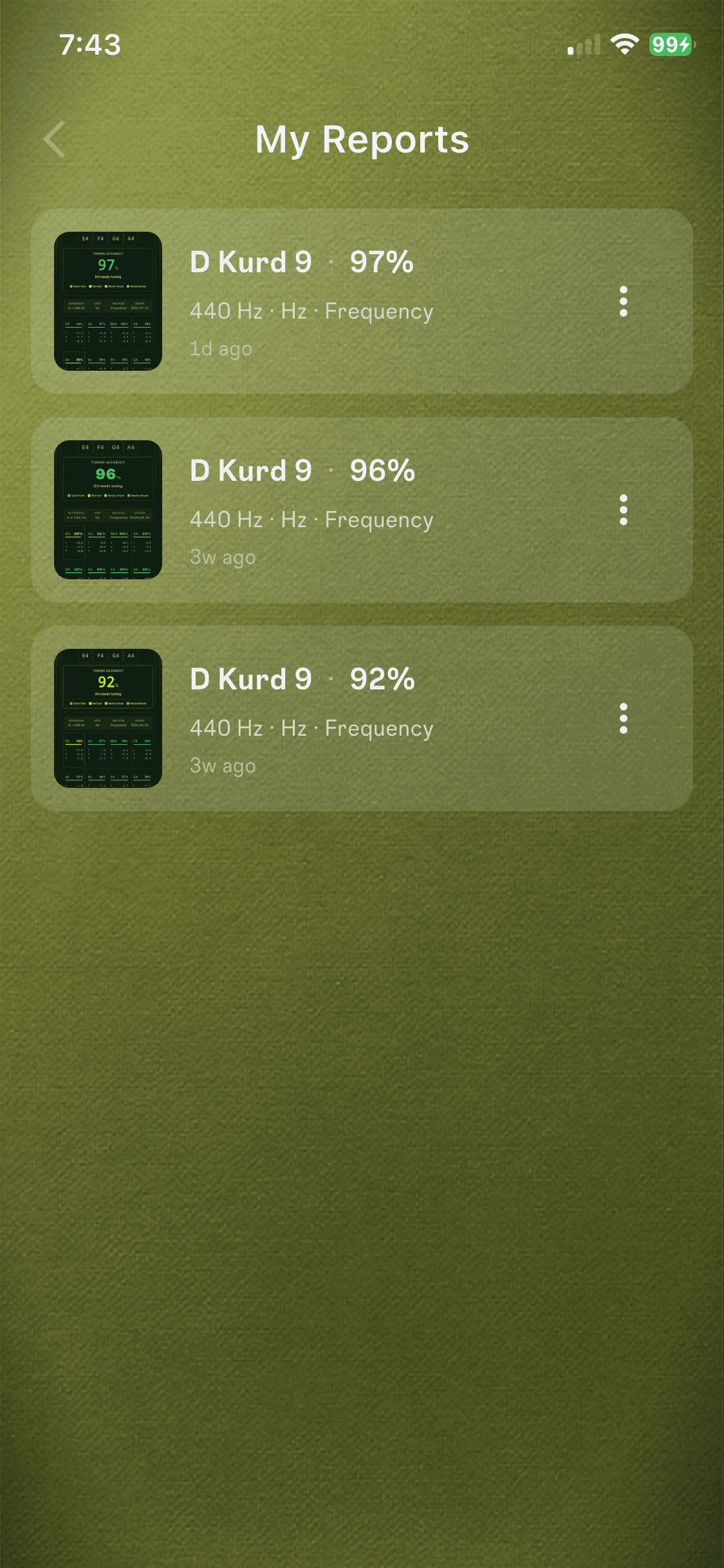
A saved report holds the scale name, per-note scores and overall grade, with the settings at the time of measurement baked into its footer.
How scoring works
Each note averages the tuning error (in cents) of its tonic, octave and compound fifth with a 3 : 2 : 1 weight, then subtracts that weighted error from 100 (a 10-cent weighted error → 90). Partials that aren't detected are left out and the rest re-normalized. The overall score is the average of the notes whose three partials were all detected, graded EXCELLENT (95+), STABLE (90+), FAIR (85+) or NEEDS TUNING (below 85).
Why cents, not Hz
Cents measure pitch as a ratio. The same Hz error is therefore a larger deviation (more cents) on low notes and a smaller one (fewer cents) on high notes — 15 cents is about ±3.8 Hz at A4, fewer Hz lower down and more Hz higher up.
If color and score were judged by Hz directly, the same Hz error would read red on a low note and green on a high one, distorting the real accuracy. sonaTune always judges color and score in cents, so the same degree of deviation always shows the same color across the instrument. (Switching the display to Hz changes only the number you see — never the color or score.)
Using the report
Real-world scenarios
Skip the paragraph — send the certificate.
Conversations get shorter, deals get faster — on sonaMall and beyond.
Show your instrument's exact state with the certificate, and get turnaround and cost answers right away.